
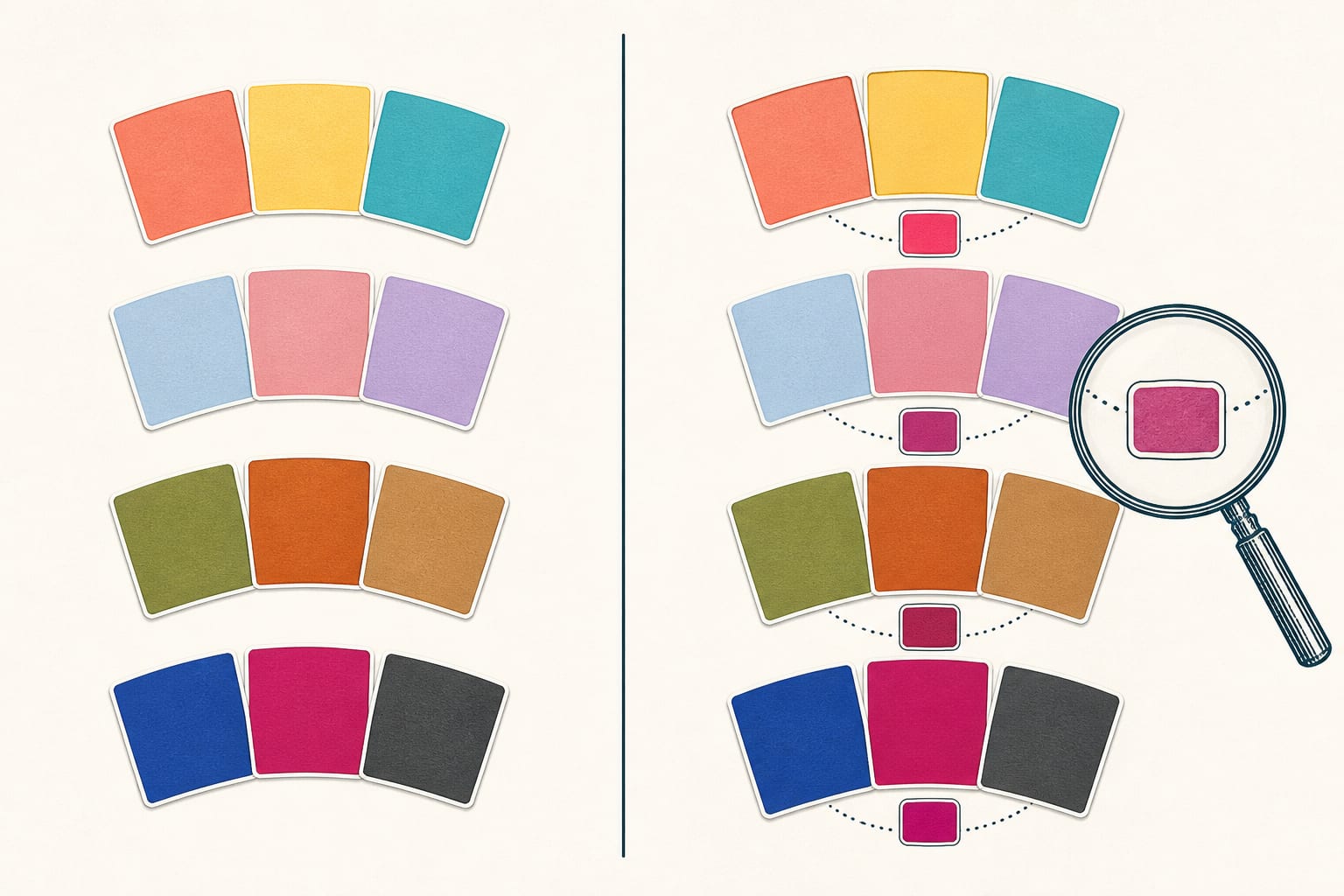
Four parent seasons, each split three ways.
The same foundation, with four extra refinement points.
At a glance
| 12 season | 16 season | |
|---|---|---|
| Best for | First-time clients | Follow-up nuance |
| Detail level | Specific enough for most people | More granular |
| Availability | Common across analysts | Less common |
| Palette support | Easy to find online | Depends on the method |
| Standardization | More consistent naming | Names vary by system |
| Cost | USD $100–$600 | USD $100–$600 |
| Main risk | Can miss edge cases | Can create label confusion |
| Best next step | Book a trained analyst | Book a specialist if 12 felt off |
The 4 season system came first
The original color analysis system used four categories: Spring, Summer, Autumn, and Winter. Each season grouped people by the broad temperature, depth, and clarity of their natural coloring.
That system was simple, but it had an obvious limit. Two people can both be Autumn and need very different colors. One might have fair skin and copper hair. Another might have olive skin and dark brown hair. Same parent season, different best palette.
Analysts split the four seasons into more precise categories to solve that problem.
What the 12 season system does
The 12 season system splits each parent season into three sub-seasons. Spring becomes Light Spring, Warm Spring, and Bright Spring. Summer becomes Light Summer, Cool Summer, and Soft Summer. Autumn and Winter split the same way.
Sub-season names vary by school. Some systems use Cool Summer, Warm Spring, Warm Autumn, and Cool Winter. SciART and other Twelve-Tone systems often use True Summer, True Spring, True Autumn, and True Winter for those pure parent-season categories.
Each sub-season is based on the strongest trait in your coloring:
- Light vs deep: how light or dark your overall coloring appears
- Warm vs cool: whether your best colors lean yellow-based or blue-based
- Bright vs soft: whether clear colors or muted colors look better on you
This system is widely used because it gives practical results without too many labels. If you are typed as Soft Autumn, you can find palettes, makeup references, and outfit examples in many places.
What the 16 season system does
The 16 season system adds four more categories to create more precision. Different 16 season methods use those extra categories in different ways.
There is not one standard 16 season system. Different methods use different names.
- True-season expansions: these separate True Spring, True Summer, True Autumn, and True Winter from adjacent warm, cool, light, deep, bright, or soft versions. These labels are for balanced, archetypal parent-season coloring, not for people who sit between two neighboring palettes.
- Between-season expansions: these add extra categories for people who sit between existing 12-season palettes. Names and definitions vary by school, so the analyst's method matters more than the label by itself.
- SciART and SciART-influenced systems: classic SciART is usually described as a Twelve-Tone method developed by Kathryn Kalisz. Some modern 16-season discussions borrow True-season language, but that does not make every SciART-style result a between-season result.
The benefit is precision. The downside is portability. A 16 season label may not mean the same thing from one analyst to another, and online palette support can be thin.
Which system should you choose first?
Most first-time clients should choose 12 seasons. It is detailed enough to make shopping easier, but common enough that your result will be easy to use after the appointment.
- You've never had a professional color analysis before
- You want a palette you can shop from immediately
- You want easier makeup and clothing references
- Your coloring fits one of the common seasonal descriptions
- You care more about practical next steps than theory
- You already had a 12 season analysis and the result felt wrong
- You keep self-testing between two close seasons
- Your coloring is a clear, balanced version of a parent season
- Your undertone is very neutral
- You want a more technical framework
- You have access to a well-trained 16 season analyst with clear deliverables
The system should make your closet easier to use. If the result gives you a label but not better buying decisions, it missed the point.
Common confusion about 12 and 16 seasons
The 16 season system is not a replacement for 12 seasons. It is a more granular version of the same color theory. Both systems look at temperature, value, and chroma. Both should use controlled lighting and drapes, not guesses from a filtered photo.
The analyst matters more than the framework. A skilled 12 season analyst will give a better result than a weak 16 season analyst. Training, lighting, draping technique, and explanation quality matter more than the number of categories.
The labels also matter less than the usable palette. A good result should tell you which colors repeat well in clothing, makeup, hair, and metals. The name is only useful if it helps you buy better things.
What to look for in an analyst
A good color analyst can explain their training, process, and deliverables before you book. Ask where they trained and which system they use. Clear answers are a good sign.
Look for drapes, not vibes. A proper color analysis compares fabric near your face and watches how your skin, shadows, eyes, and overall clarity respond. A photo-only season label is closer to a guess than an analysis.
Virtual analysis can work, but the setup matters. The analyst should require natural light, no makeup, neutral clothing, and unedited photos or live video. Compressed selfies in bathroom lighting are not enough.
You should leave with a usable palette. Fabric swatches, digital colors, makeup direction, and metal guidance are all practical deliverables. A season name by itself is not enough.
How much should you expect to pay?
Color analysis pricing usually depends on format, city, and analyst reputation more than the number of seasons. In 2026, online quizzes and apps are often free to USD $30. They can be useful as a starting point, but they are not a professional analysis.
Virtual analysis with a trained analyst often falls around USD $100 to $300. In-person analysis often falls around USD $200 to $600, with premium analysts charging above USD $500. A 16 season appointment is not automatically more expensive than a 12 season appointment.