
Online vs in-person color analysis at a glance
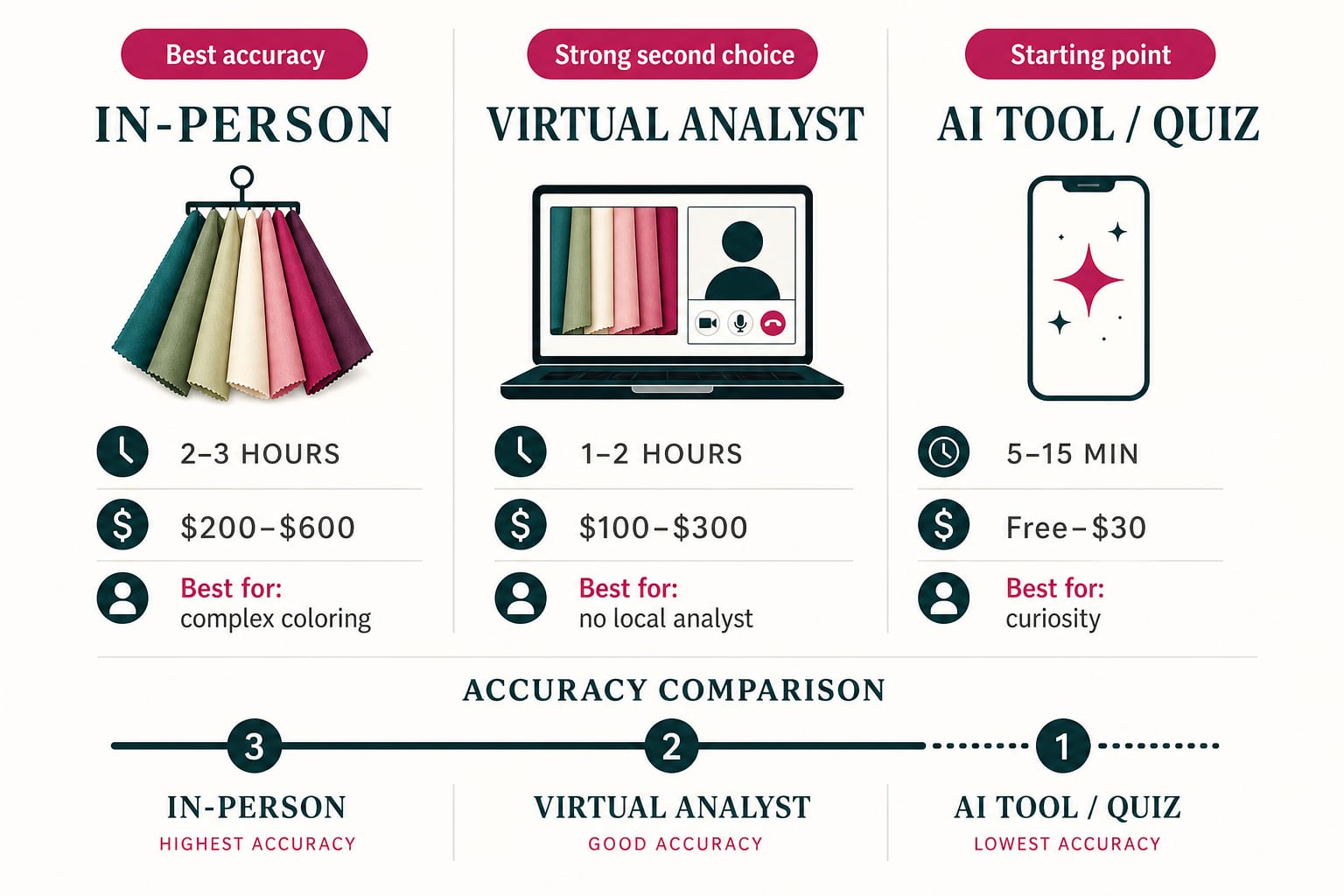
| Factor | In-person | Virtual analyst | AI tool or quiz |
|---|---|---|---|
| Best for | Complex coloring and highest accuracy | Most people with a good analyst | Curiosity and rough starting points |
| Typical cost | USD $200 to $600 | USD $100 to $300 | Free to USD $30 |
| Accuracy ceiling | Highest | Good with a strong process | Low and inconsistent |
| Main input | Physical drapes near your face | Photos, video, and digital draping | Uploaded photo or quiz answers |
| Biggest risk | Poor analyst or poor lighting | Bad photos or thin process | Camera bias and false confidence |
| Best deliverables | Palette, drapes, makeup, metals, shopping guidance | Palette, report, call, hex codes, shopping guidance | Fast season guess |
| Use for hair color | Yes | Sometimes | No |
Why in-person color analysis is still the standard
Color analysis depends on how light, fabric, and skin interact. In person, the analyst can place physical drapes next to your face and watch the effect directly. That is hard to replace with a screen.
The analyst is not simply matching a season to your hair, eyes, or ethnicity. They are watching whether a color makes the complexion look clearer, more shadowed, duller, harsher, or more even.
In-person analysis is strongest when the case is subtle. Neutral undertones, olive skin, dyed hair, and between-season coloring all leave less room for bad photos or automatic camera correction.
The analyst controls the lighting instead of relying on whatever your phone captured.
Fabric drapes show how color reflects onto your skin in real time.
The analyst can compare close colors quickly and adjust the session as your face responds.
There is no camera white balance, smoothing, or compression changing the evidence.
Where virtual color analysis works
Virtual color analysis works when a trained analyst has enough good evidence. The format is not the problem by itself. The problem is a thin process.
Specific photo instructions for light, makeup, clothing, background, and camera settings.
Multiple photos or video instead of one selfie.
A process for comparing colors near your face, not just reading your hair and eye color.
A final palette with practical notes for makeup, metals, hair color, and shopping.
Clear explanation of what happens if your photos are not good enough.
A virtual analyst who asks for careful photos, reviews color comparisons, and explains the result can give a usable palette. A cheap result from one selfie, a quiz, or a hair-and-eye stereotype is closer to a guess.
Where virtual color analysis falls short
Virtual analysis loses some information because the camera sits between your face and the analyst. That matters most when the differences between seasons are small.
- Subtle under-eye shadows, redness, greyness, and jawline changes can be harder to see.
- Olive and neutral undertones often photograph differently than they look in person.
- Dyed hair can pull the analysis warmer, cooler, darker, or softer than your natural coloring.
- Conflicting past results are harder to settle without physical drapes.
The truth about AI color analysis tools
AI color analysis tools read a photo. They do not see how fabric changes your skin, shadows, eyes, and overall clarity in real time. The result depends heavily on lighting, camera processing, filters, hair color, and the photo you choose.
The accuracy problem is not theoretical. In a Created Colorful test of free online photo analyzers, 6 of 23 participants received a result that matched Created Colorful's reference palette, a 26% match rate. The same person could also receive different results from different photos. Created Colorful published the experiment in its comparison of color analysis options.
AI tools still have a place. Use them if you are curious, trying to learn the language of color analysis, or narrowing a broad direction before booking. Do not use them for expensive wardrobe, makeup, or hair decisions.
This matters for people who have been typed by stereotypes before. Dark hair, light eyes, gray hair, olive skin, and deeper skin can all confuse tools that are reading a photo instead of a live color response.
What you actually pay
| Format | Typical 2026 cost | What you get |
|---|---|---|
| AI tool or quiz | Free to USD $30 | A fast guess based on a photo or questionnaire |
| Virtual analyst | USD $100 to $300 | Palette, report, video or photo review, and shopping guidance |
| In-person analyst | USD $200 to $600 | Draping session, palette, makeup advice, and in-room comparison |
| Premium analyst | USD $500+ | Full service, stronger brand name, or more styling support |
How to pick the right format
Book in-person if
- Budget is not the main constraint.
- You have olive or neutral undertones.
- Your past result felt wrong.
- You want makeup and shopping help in the room.
Book virtual if
- There is no good analyst near you.
- You can follow photo instructions carefully.
- You want a specific analyst who works online.
- Your coloring is not especially complex.
Use AI tools if
- You are just curious.
- You want a rough starting point.
- You are not making expensive decisions from it.
- You know the result may be wrong.
What matters more than the format
A trained analyst working virtually can outperform an untrained analyst working in person. The format matters, but the analyst's eye, training, and process matter more.
They can name their training program and explain the system they use.
They describe the full process before you book.
They show clients with a range of skin tones, undertones, and contrast levels.
They use drape comparisons, either physical or carefully controlled virtual comparisons.
They give clear deliverables. A season name by itself is not enough.