
10 must-ask questions at a glance
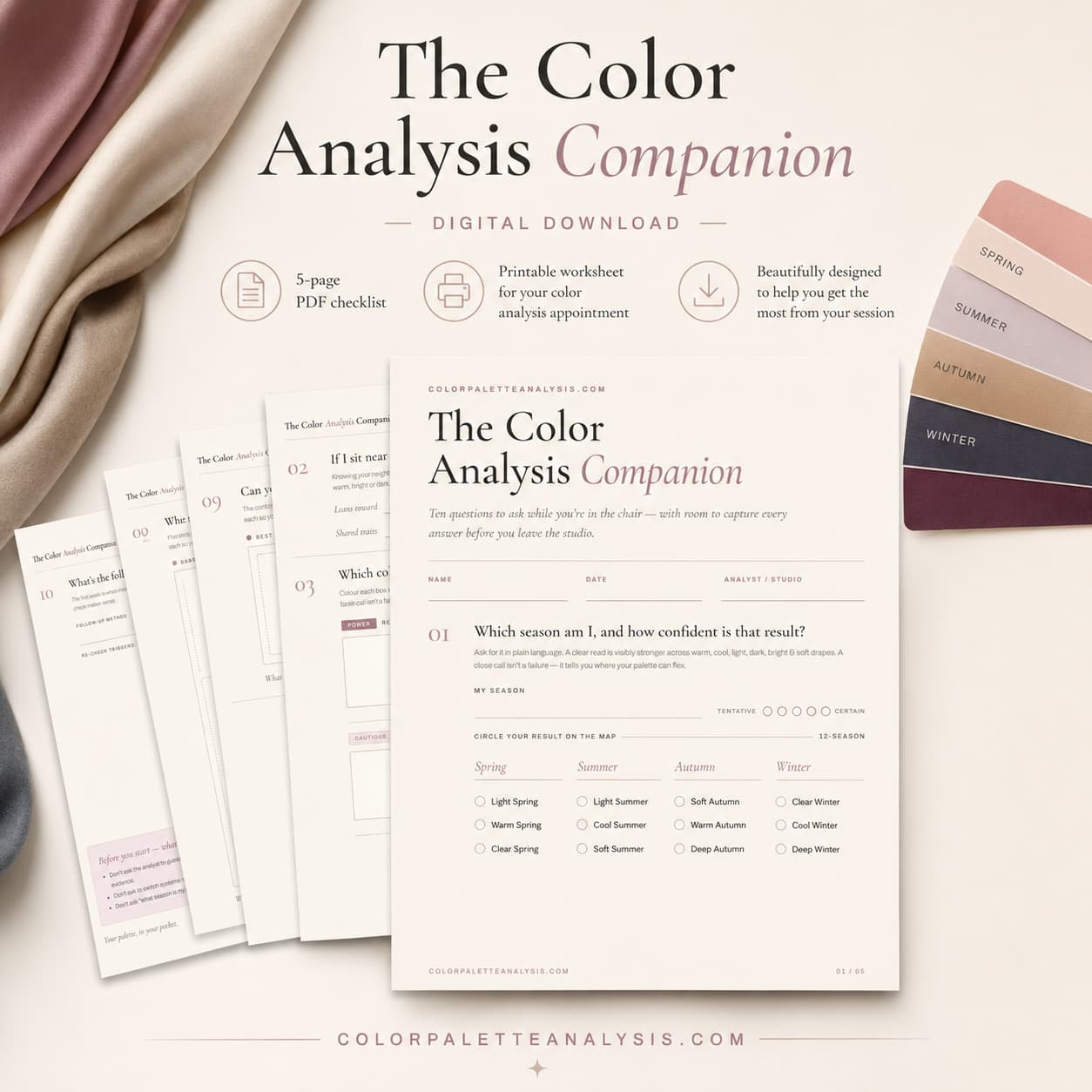
The questions are free. The worksheet captures the answers.
Your analyst will move quickly from drape to drape under controlled lighting. It is easy to lose the exact wording around sister seasons, cautious colors, metals, makeup, and follow-up. The Appointment Checklist is the 5-page PDF you fill in during the session, so you leave with usable notes instead of only a season name.
Booked a 16-season analysis? Get the 16-season version →
Instant PDF download. Use code EARLY at checkout for 75% off. Download problem? Use the contact form.
1. Which season am I, and how confident is that result?
Ask for the season name in plain language and ask how confident the analyst is. A trained analyst can tell you whether your result was clear within a few drapes or whether it sat between two seasons until late in the session.
A confident result usually means one season was visibly stronger across warm, cool, light, dark, bright, and soft drapes. A close call is not a failure. It tells you where your palette can flex.
If you booked a system you do not know yet, read 12 vs 16 season color analysis before you leave so the answer makes sense in context.
2. If I sit near another season, where do I overlap?
Some systems define sister or neighboring seasons. If your analyst uses that model, ask which nearby palettes overlap with yours and which traits you share with them. This is useful when the garment in your hand sits between palettes.
For example, a Soft Autumn may share muted, low-chroma colors with Soft Summer, while its warmer muted shades may sit closer to Warm Autumn. Knowing the overlap helps you trust a "close enough" color and reject one that is too cool, too warm, too bright, or too dark.
Boundary awareness also matters across formats. Online analysis can place you near a boundary, which is why online vs in-person color analysis is worth reading before you commit to one method.
3. Which colors are my power colors, and which are my cautious ones?
A palette is not a flat list. Some colors will be more reliable in consistent natural or studio lighting. Others may sit inside the palette but only work in specific fabrics, finishes, or contexts.
Ask the analyst to point out three or four power colors you can rely on for interviews, weddings, and photos. Then ask which colors are cautious, usually colors near the edge of the palette that demand the right texture, depth, or distance from the face.
Mark these in your notes. A swatch fan alone does not tell you which color to put against your face on a bad skin day.
4. What is my best neutral and my worst neutral?
Neutrals do most of the work in a wardrobe. Ask the analyst to name your single best neutral and your worst neutral by name, not just by category.
"Soft ivory, not bright white" is more useful than "your whites." "Warm chocolate brown, not black" is more useful than "your darks." A specific answer makes shopping faster and reduces returns.
For a deeper guide once you know your season, read best neutrals for each season.
5. Silver, gold, rose, or mixed: what works on me?
Metals sit at your jawline, ears, neck, and wrists. The wrong metal flattens skin in the same place a wrong drape does. Ask the analyst to test silver, gold, and rose gold against your face and tell you which is primary.
Many palettes accept more than one metal. A clear answer might be "gold is primary, rose gold is fine, avoid bright silver near the face." That kind of detail is more useful than "warm metals only."
If you wear glasses every day, ask about frame metal and frame color while you are at it. Frame color affects how skin reads more than most people expect.
Get one sample page free
The season and sister-season capture sheet, sent to your inbox. Print it before your appointment and decide for yourself whether the full 5-page checklist is worth it.
One email with the sample. Occasional notes when a new checklist drops. Unsubscribe anytime.
6. What lipstick, blush, and eyeshadow direction matches my palette?
Makeup follows the same warm, cool, light, dark, bright, and soft logic as clothing. Ask for a direction in each category, not specific product names. Products change. The direction does not.
A useful answer might be "lipstick in soft warm rose to terracotta, blush in muted peach, eyeshadow in warm taupes and soft browns." That gives you a rule you can apply at any drugstore or counter.
If your studio package includes makeup matching, ask whether you should bring current products to test. If product sorting is included, ask the analyst to group what you own into "keep, swap, donate."
7. What hair color direction supports my palette?
Hair color changes the contrast around your face every day. Ask the analyst for palette-safe color families, not a single salon formula.
A clear answer might be "soft warm browns, avoid very ashy, very platinum, or jet-black finishes near the face." Bring that direction to your colorist, who should translate it into levels and formulas.
If you are considering a major hair change, ask the analyst whether it should happen before or after the appointment. If the analyst prefers after, the new color can be chosen with the confirmed palette in mind.
8. How do I handle black, navy, white, and denim?
These four staples sit in almost every wardrobe. Ask the analyst to give you a specific verdict on each one because they decide how much of your existing closet still works.
Black may be a power color, a special-occasion color worn away from the face, or a near-no. Navy is rarely a flat ban. Most palettes have a version that works. White is almost always a question of warmth and brightness. Denim is a question of wash, not a yes or no.
If your verdict on black is "not near the face," read can every season wear black before you donate your wardrobe.
9. Can you show me my best drape next to my worst drape?
This is the question most clients forget. Ask for a side-by-side comparison of the most flattering drape and the most unflattering drape from the session, held against your face at the same time.
The contrast is what teaches your eye. Once you have seen your face under a wrong color and a right color in the same lighting, you can recognize the difference in a store on your own.
If photos are allowed, take one of each. A photo of your worst drape is more useful in a fitting room than any swatch fan.
10. What is the follow-up policy if I get confused later?
The first week after an analysis is when most clients second-guess the result. Ask before you leave how the analyst handles follow-up questions. Email, a short call, a free re-check, or a paid extension are all normal.
Also ask when a re-check makes sense. Gray transition, a major hair-color change, or a large shift in contrast can affect how your palette reads. A good analyst will tell you when to come back and when the original palette still applies.
If you are not sure your analyst was the right fit, read how to choose the right color analyst before booking a second opinion.
What not to ask during the session
Do not ask the analyst to guess your season before draping starts. That short-circuits the process and anchors them to a result they should reach through evidence.
Do not ask to switch systems mid-session. If you booked a 12-season analysis and want a 16-season tonal result, that is a separate appointment. Trying to convert on the spot dilutes both.
Do not ask "what season is my friend?" from a photo. A reputable analyst will decline because a photo cannot be controlled for lighting, white balance, or makeup.